
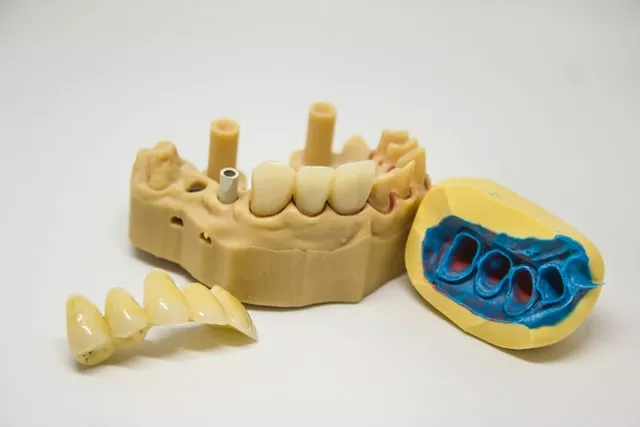
Even if your damaged tooth has been damaged by extensive tooth decay, it is still viable witht he right treatment. If a partial or full crown has been recommended for you, know that they are designed to save your teeth. In that case, the clinical priority is to provide the highest quality tooth restoration possible.
Let’s compare between a partial and a full crown, so you’ll know which one fits you.
Partial Crown
A partial crown is a variant of a dental crown solution in which a smaller part of the tooth is covered to restore its form and function. The procedure requires at least two visits; the first consists of taking a mold of your teeth and your bite and sending them to us to create the customized partial crown. The second step involves placing the partial crown over your natural tooth and securing it in place with dental cement, and checking that it fits properly.
Your partial crown can restore larger cavities and covers at least one tooth cusp, as it acts as an artificial replacement for the lost substance. As such, it is bonded to your natural tooth, now restored in terms of the ideal look, and shape.
Your partial crown can last 20 years once fitted if you commit to excellent oral hygiene and a regular schedule of appointments with your dentist. From taking the mold to creating your customized partial crown, a fully digital process can be completed in only seven days.
Full Crown
A full crown is made from high-performance ceramic, and it can be recommended for teeth that need extensive restorations. Essentially, a tooth-shaped cap is designed to protect, strengthen, and hide a lost tooth in its entirety.
A full crown is recommended when a tooth is severely chipped, fractured, or decayed to the point of needing large fillings. It is also used to cover the appearance of teeth after root canal treatments, or cosmetic, reconstructive efforts.
Another option is a partial crown, which covers only the front portion of the tooth, and can help prevent sensitivity issues. Partial crowns tend to have a shorter lifespan, about ten years or so, but they’re often more cost-effective than full crowns.
Which One Is Best for You?
If you have a tooth that needs extensive restoration, we suggest discussing your options with our dentist. Your tooth may be covered with enamel cracks, or it may have a large filling due to decay. In the former case, a full crown would be appropriate; in the latter, a partial crown would restore the tooth to a healthful condition.
Your dentist will present options for the treatment. If your tooth still has good support in the tooth’s core, you may choose to have a partial crown. This option preserves more of the tooth’s strength to last longer and not require another visit to restore it later on.
Generally, If your tooth has significantly deteriorated, and even a partial crown won’t help, you’ll need a full crown. This will restore more of the biting surface, but it will require more visits in the long term. Either way, you’ll get a custom-made crown that’s an exact match to your other teeth in color and size so that your restored tooth will look entirely natural.
If you are looking for an all-around dental provider and cosmetic dental clinic in the Oro Valley to take care of all dental needs, visit Oro Valley Dental Arts. We are Southern Arizona’s premier dental care provider, with premier services such as Invisalign dental crowns, family dentistry, cosmetic dentistry, dental veneers, dental implants, and teeth whitening. Get your confident smile back by booking an appointment with us today!
Recent Comments